KNX RF thermostats are among the most technically sensitive wireless KNX devices. Unlike switches, which send only occasional telegrams, thermostats measure, calculate, and communicate continuously. This makes their design, configuration, and placement far more critical to system stability, comfort, and battery life.
This article is a full technical deep dive intended for consultants, system designers, and integrators. It explains how KNX RF thermostats work internally, how they interact with HVAC systems, what design limits exist, and how to avoid the most common (and costly) mistakes.
No marketing claims. No shortcuts. Only engineering reality.
1. What Is a KNX RF Thermostat?
A KNX RF thermostat is a wireless KNX input and control device that:
- Measures room temperature (and sometimes humidity)
- Compares it to a setpoint
- Generates KNX control telegrams
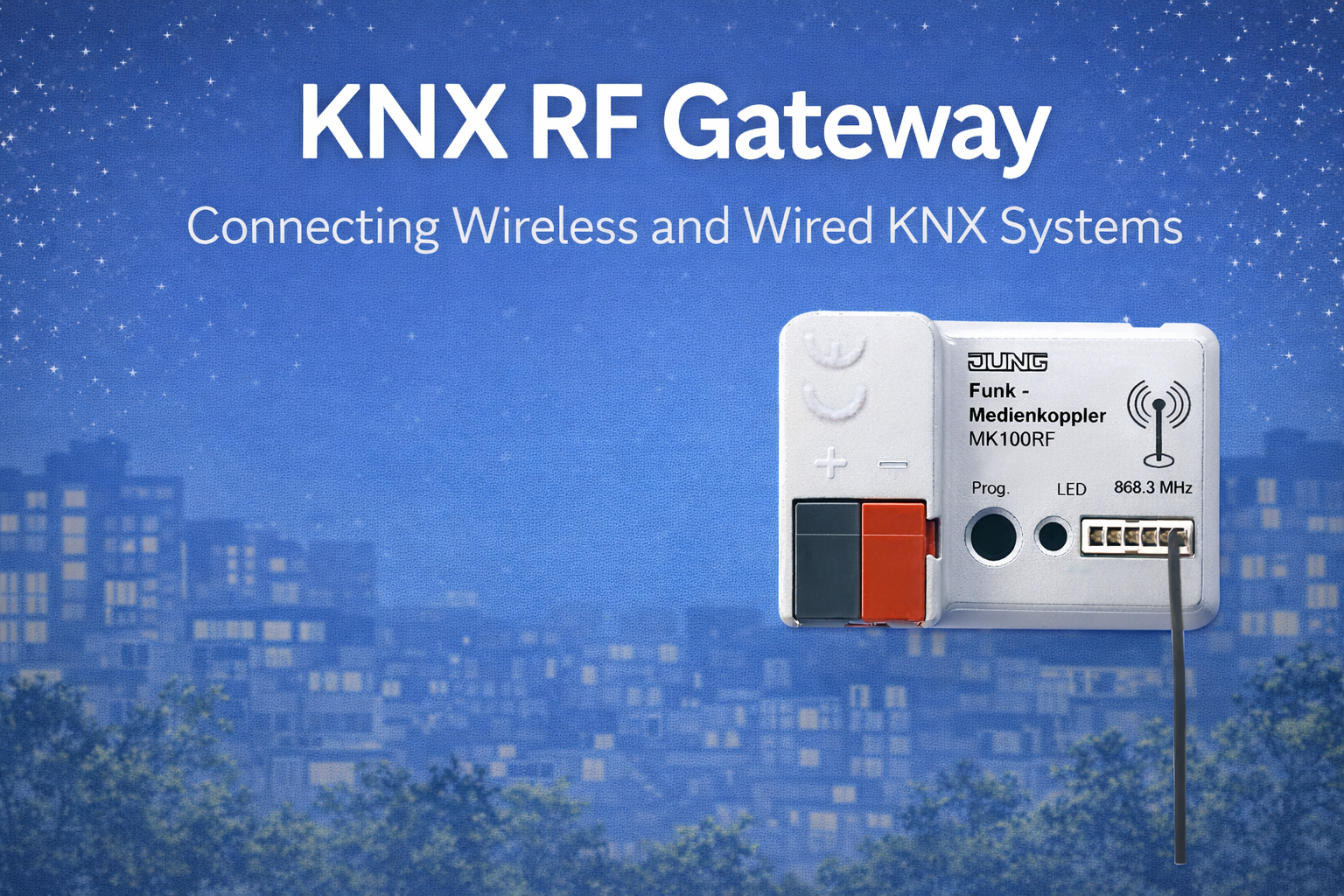
- Communicates wirelessly with the KNX system via an RF gateway
Important distinction:
A KNX RF thermostat does not control HVAC power directly.
It sends control values (setpoints, operating modes, control outputs) to wired or wireless actuators that drive valves, fan coils, or HVAC interfaces.
Its behavior and interoperability are defined by the KNX RF specification maintained by the KNX Association.
2. Functional Architecture of a KNX RF Thermostat
Technically, a KNX RF thermostat combines four functions in one device:
- Sensing
- Temperature sensor (NTC / digital IC)
- Optional humidity sensor
- Control Logic
- PI or PWM control algorithm
- Heating / cooling mode logic
- Comfort, standby, night modes
- User Interface
- Buttons, rotary dial, or touch
- Display (LCD / e-ink in some models)
- Setpoint adjustment
- Wireless Communication
- KNX RF telegram transmission
- Secure or non-secure RF communication
- Gateway-based system integration
This combination makes RF thermostats far more complex than RF switches.
3. KNX RF Thermostat vs KNX RF Temperature Sensor
This distinction is frequently misunderstood.
KNX RF Temperature Sensor
- Measures temperature
- Sends value to KNX
- Control logic happens elsewhere (logic module, actuator)
KNX RF Thermostat
- Measures temperature
- Performs control calculation internally
- Sends control output (e.g., heating demand)
Design implication:
Thermostats reduce system logic complexity but increase device responsibility and RF traffic.
4. Control Modes Used in KNX RF Thermostats
4.1 PI (Proportional–Integral) Control
Most KNX thermostats use PI control.
Characteristics
- Output proportional to temperature difference
- Smooth regulation
- Suitable for underfloor heating and fan coils
Typical outputs
- 0–100% heating demand
- 0–100% cooling demand
4.2 PWM (Pulse Width Modulation)
Used mainly for thermal actuators.
Characteristics
- Time-based on/off control
- Longer control cycles
- Lower RF traffic
Design note:
PWM is often more RF-friendly than fast PI updates.
5. Communication Objects & Telegram Behavior
A KNX RF thermostat typically exposes:
- Actual temperature
- Setpoint
- Operating mode
- Heating / cooling demand
- Status and fault objects
RF-Specific Concern
Each enabled object can generate RF telegrams.
Poor configuration example
- Cyclic temperature update every minute
- Continuous demand updates
- Multiple feedback objects enabled
This leads to:
- High RF network load
- Rapid battery drain
- Gateway congestion
6. Battery-Powered vs Mains-Powered RF Thermostats
Battery-Powered RF Thermostats
Advantages
- Easy retrofit
- No wiring required
- Flexible placement
Limitations
- Battery life depends heavily on configuration
- Display and backlight increase consumption
- Frequent RF transmission is costly
Typical battery life
- Well-designed: 2–5 years
- Poorly configured: months
Mains-Powered RF Thermostats
Advantages
- No battery concerns
- More frequent updates possible
- Bright displays and touch UI
Limitations
- Requires power wiring
- Less flexible in retrofits
Design recommendation
For continuous HVAC control, mains-powered RF thermostats are technically superior.
7. RF Traffic Impact of Thermostats (Critical Section)
KNX RF thermostats are among the highest RF traffic generators.
Reasons:
- Periodic measurement
- Control recalculation
- Mode changes
- Feedback transmission
Key Engineering Rule
RF thermostats must be configured to communicate only when values change meaningfully, not continuously.
8. KNX RF Secure and Thermostats
KNX RF Secure adds:
- Encryption
- Authentication
- Replay protection
Technical impact
- Slightly larger telegrams
- Minimal extra RF on-time
Important
RF Secure does not significantly reduce battery life.
Bad configuration does.
Security should never be disabled to “save power”.
9. Placement Rules for Accurate Temperature Control
Placement affects measurement accuracy more than RF quality.
Correct Placement
- Interior wall
- Away from sunlight
- Away from air drafts
- Approx. 1.4–1.6 m height
Incorrect Placement
- Near windows
- Above radiators
- On external walls
- Inside metal back boxes
Incorrect placement leads to poor comfort, not just RF issues.
10. KNX RF Thermostats in Hybrid Systems
Best-practice architecture:
- RF thermostat → RF gateway
- Gateway → KNX TP / IP backbone
- Wired actuators control valves / fan coils
Why this works
- RF handles sensing and user input
- Wired KNX handles actuation and power
- System remains scalable and stable
Avoid fully RF-based HVAC actuation for large zones.
11. Common Design Mistakes (Seen on Real Projects)
- Treating thermostats like simple sensors
- Enabling cyclic updates “just in case”
- Using battery RF thermostats for fast control loops
- Overloading one RF gateway with many thermostats
- Ignoring commissioning impact on batteries
Most thermostat issues are design mistakes, not device faults.
12. Commissioning Best Practices
- Commission RF gateway first
- Configure control logic before enabling communication
- Minimize downloads to battery devices
- Test comfort behavior, not just telegram flow
- Verify demand output stability over time
Commissioning discipline directly affects battery life and comfort.
13. Maintenance & Lifecycle Expectations
For professional projects:
- Document battery type and replacement cycle
- Plan access for replacement
- Log configuration parameters
- Avoid “temporary” settings left in production
RF thermostats demand engineering ownership, not casual setup.
14. When KNX RF Thermostats Are the Right Choice
Good fit
- Apartment retrofits
- Hotels and serviced apartments
- Zones where wiring is impractical
- Hybrid KNX systems
Poor fit
- Very fast control loops
- Central plant control
- Safety-critical HVAC functions
Conclusion
KNX RF thermostats are powerful, flexible devices—but they are not forgiving. They combine sensing, control logic, user interaction, and wireless communication in one unit. When designed correctly, they deliver excellent comfort and clean integration. When designed poorly, they overload RF networks, drain batteries, and frustrate users.
Reliable KNX RF thermostat systems are not achieved by tweaking parameters later.
They are achieved by correct design, disciplined configuration, and realistic expectations.
Used properly, KNX RF thermostats are a valuable part of modern hybrid KNX HVAC systems.