Introduction
Wireless automation offers flexibility, faster installation, and easy retrofitting—but it also raises concerns about data security. Radio signals travel beyond walls, making them vulnerable if not properly protected. KNX RF Secure was developed to solve this challenge by adding strong encryption and authentication to wireless KNX communication. It allows professionals to use wireless devices confidently in homes, hotels, offices, and commercial buildings without compromising safety or reliability.
This article explains KNX RF Secure in a clear and practical way, covering how it works, why it matters, how it compares with non-secure RF, and where it should be used.
Why Security Is Important in Wireless Automation
Unlike wired systems, wireless signals can be received outside the building. Without protection, this may lead to unauthorized access or manipulation.
Risks of unsecured wireless systems:
- Commands can be intercepted
- Messages can be replayed later
- Fake devices may send control signals
- System behavior can be altered remotely
Secure communication ensures that only authorized devices can control the automation system.
What Is KNX RF Secure?
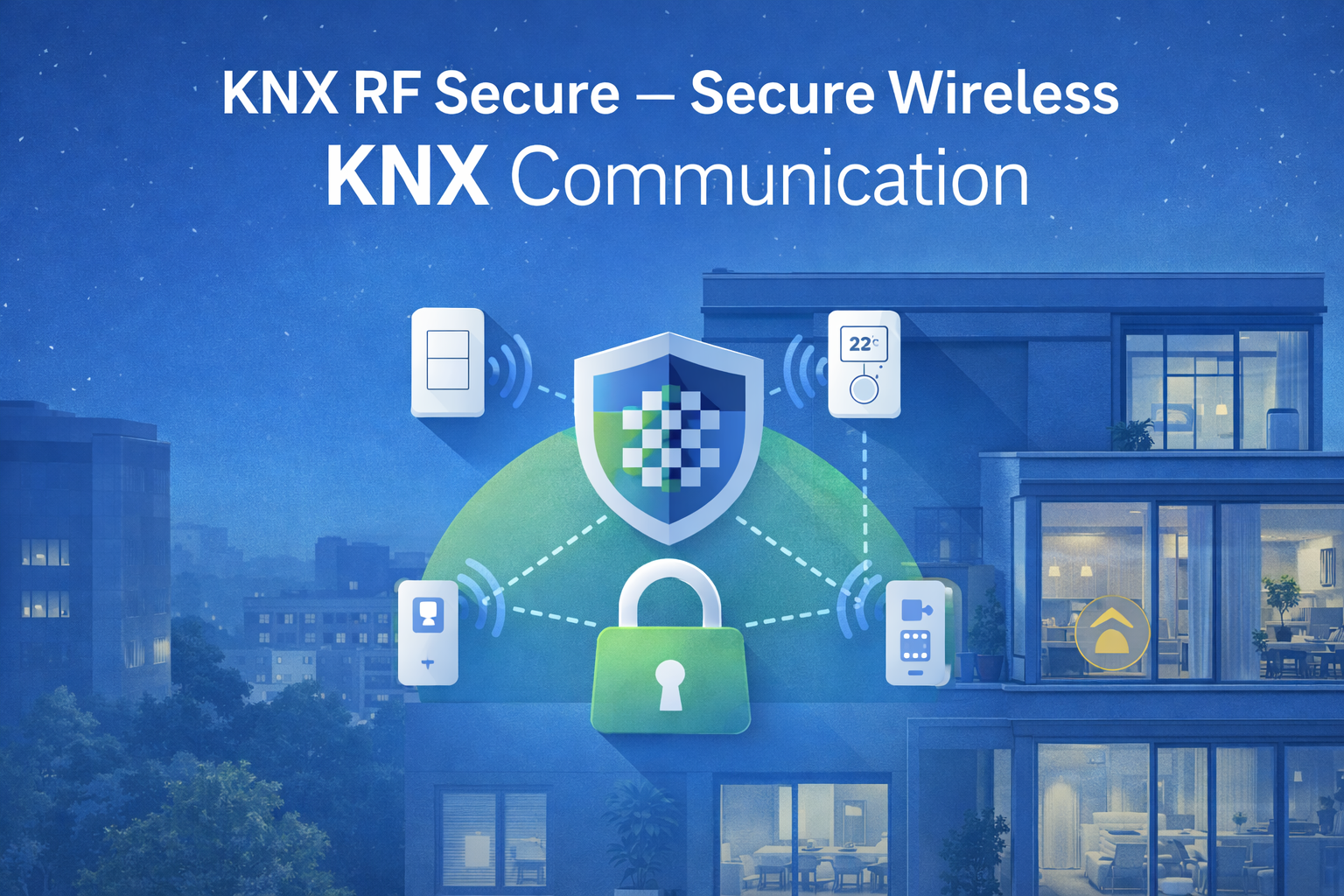
It is an enhanced wireless communication method within the KNX standard. It adds a dedicated security layer that protects every message sent over radio.

Key features:
- Encrypted wireless telegrams
- Authentication of sending devices
- Protection against replay attacks
- Fully integrated with ETS
- Manufacturer-independent implementation
Once commissioned, the security works automatically in the background without user interaction.
How KNX RF Secure Works (Simple Explanation)
Each wireless message is encrypted before transmission. The receiving device verifies the sender and checks whether the message is valid and untampered.
What happens during communication:
- Device encrypts the command
- Encrypted message is transmitted over RF
- Receiver verifies authenticity
- Command is executed only if valid
This process happens in milliseconds and does not affect system response time.
Encryption Technology Used
KNX RF Secure uses AES-128 CCM, a widely trusted encryption standard.
What AES-128 CCM provides:
- Confidentiality – data cannot be read
- Integrity – data cannot be changed
- Authentication – sender identity is verified
This same technology is used in banking, industrial control, and secure networking systems.
Protection Against Common Wireless Attacks
| Threat Type | How It Is Prevented |
|---|---|
| Eavesdropping | Encrypted data cannot be read |
| Replay attacks | Sequence counters block reused messages |
| Telegram injection | Unauthorized devices are rejected |
| Device impersonation | Authentication validates identity |
| Message tampering | Integrity checks detect changes |
KNX RF Secure vs Standard KNX RF
| Feature | Standard Wireless | Secure Wireless |
|---|---|---|
| Encryption | No | Yes |
| Authentication | No | Yes |
| Replay protection | No | Yes |
| ETS key handling | No | Yes |
| Professional suitability | Limited | Recommended |
| Compliance | Legacy | Current standard |
For new installations, secure communication is strongly recommended.
ETS Commissioning – What Installers Need to Know
Secure devices are commissioned through ETS using a factory-assigned key.
Typical commissioning steps:
- Add device to ETS project
- Import product database
- Enter or scan factory setup key (QR code)
- Assign group addresses
- Download configuration
- Test secure communication
Once completed, all communication remains encrypted automatically.
Key Management Made Simple
Each device has its own unique security credentials.
Important points:
- Keys are created at the factory
- Keys are stored securely in ETS
- Keys cannot be read or copied
- Reset is required if device ownership changes
- Project backups are critical
This approach prevents unauthorized reuse or system cloning.
Compatibility with Other Secure KNX Media
Secure wireless communication works seamlessly with other KNX media.
Supported combinations:
- Wireless + wired (TP)
- Wireless + IP backbone
- Full hybrid secure systems
Media couplers ensure encrypted messages remain protected across the entire system.
Typical Use Cases
Ideal environments:
- Apartment renovations
- Hotels and hospitality projects
- Heritage buildings
- Offices without ceiling access
- Rental properties
- Modular or prefabricated buildings
- Wireless wall switches and sensors
- Temporary installations
Security makes wireless automation suitable even for sensitive environments.
Design Best Practices
✔ Place devices away from metal enclosures
✔ Plan repeater positions carefully
✔ Avoid unnecessary retransmissions
✔ Monitor battery status
✔ Keep ETS security backups safe
✔ Combine with wired backbone when possible
Good planning ensures long-term stability and reliability.
Limitations to Consider
While secure wireless automation is powerful, some factors should be considered:
- Slightly higher commissioning effort
- Marginally higher device cost
- Battery replacement for some devices
- Proper documentation required
These are minor trade-offs compared to the security benefits.
Comparison with Other Wireless Systems
| Aspect | KNX RF Secure | Zigbee / Z-Wave |
|---|---|---|
| Encryption | Standardized | Varies by vendor |
| Configuration | ETS | App or cloud based |
| Vendor independence | High | Limited |
| Long-term support | Excellent | Platform dependent |
| Professional use | Yes | Mostly consumer |
KNX RF Secure is designed for professional building automation, not DIY smart homes.
Future of Secure Wireless KNX
Wireless KNX continues to evolve with better reliability, improved coexistence, and lower energy consumption. Security remains a core principle, ensuring that future devices remain compatible and protected. This long-term approach makes KNX a stable choice for buildings with long operational lifecycles.
Conclusion
KNX RF Secure brings trust, safety, and professionalism to wireless building automation. By combining strong encryption, authenticated devices, and ETS-based commissioning, it allows wireless control without compromising system integrity. For modern installations, secure communication is no longer optional—it is essential.