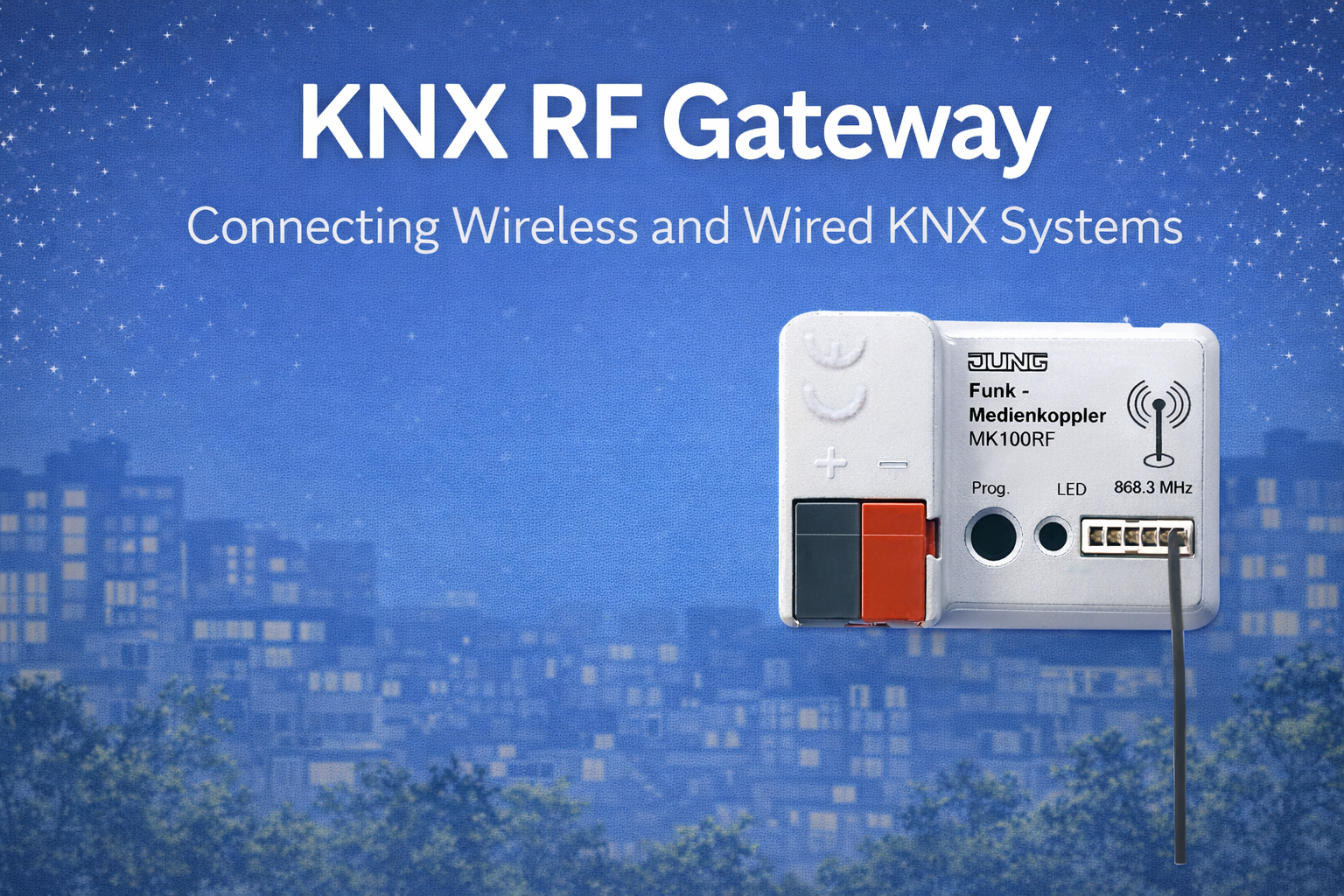
Introduction
When system integrators talk about wireless reliability, the discussion almost always comes down to frequency. Many wireless automation systems struggle not because of poor devices, but because the chosen frequency band is crowded, unstable, or poorly suited for buildings.
KNX RF takes a different approach. Instead of chasing high data rates, it uses a carefully selected frequency band optimized for building automation reliability. Understanding this frequency choice—and its real-world implications—is critical for designing dependable KNX RF systems.
This article explains how KNX RF frequency works, why 868 MHz was chosen, what regulations apply, and how integrators can achieve predictable performance on site.
1. Why Frequency Matters in Building Automation
Wireless automation is not about streaming data. It is about:
- Switching lights reliably
- Sending sensor states consistently
- Ensuring commands are received every time
In buildings, radio signals must pass through:
- Concrete slabs
- Brick walls
- Metal switch boxes
- Furniture and human bodies
The frequency band determines how well signals survive these obstacles. A poor frequency choice leads to:
- Missed telegrams
- Intermittent operation
- Difficult commissioning and callbacks
KNX RF avoids this by using a frequency optimized for range, penetration, and stability, not speed.
2. KNX RF Frequency Band Overview
KNX RF primarily operates in the 868 MHz ISM band, a license-free frequency range used across many regions for industrial, scientific, and medical applications.
This choice is defined and maintained by the KNX Association and is part of the official KNX standard—not a manufacturer decision.
Key Characteristics of 868 MHz
- Sub-GHz frequency
- Good wall penetration
- Lower congestion compared to 2.4 GHz
- Optimized for short, reliable telegrams
This makes it ideal for low-data, high-reliability automation systems.
3. Why KNX RF Uses 868 MHz (Not 2.4 GHz)
Many consumer wireless systems operate at 2.4 GHz because it supports higher data rates. KNX deliberately avoids this band.
Comparison at a Glance
| Aspect | 868 MHz (KNX RF) | 2.4 GHz (Wi-Fi / Zigbee) |
|---|---|---|
| Wall penetration | Excellent | Moderate to poor |
| Interference | Low | Very high |
| Range (indoor) | Longer | Shorter |
| Data rate | Low | High |
| Suitability for automation | Very high | Mixed |
Integrator insight:
Automation systems do not need bandwidth—they need certainty. KNX RF prioritizes signal integrity over speed.
4. Regulatory Framework & Compliance
License-Free, But Not Rule-Free
Although 868 MHz is license-free, it is regulated. Devices must comply with:
- Maximum transmit power
- Duty cycle limitations
- Regional radio regulations
KNX RF devices are certified to operate within these limits, ensuring:
- Legal operation
- Coexistence with other systems
- Predictable behaviour
This is one reason KNX RF devices from different manufacturers interoperate reliably.
5. Duty Cycle & Why It Matters
One key regulation in the 868 MHz band is duty cycle limitation.
In simple terms:
- Devices cannot transmit continuously
- Telegrams must be short and infrequent
KNX RF is designed around this:
- Telegrams are compact
- Communication is event-based
- Devices stay silent unless needed
This design:
- Reduces interference
- Increases battery life
- Improves overall system reliability
6. Real-World Range Expectations
Typical Indoor Performance
- 20–30 meters through standard walls
- Multiple rooms in residential buildings
Open Space
- Significantly longer range
- Often exceeding datasheet values
What Affects Range Most
- Reinforced concrete
- Metal enclosures
- Lift shafts
- Electrical panels
Important:
Manufacturer range figures are measured under ideal conditions. Integrators should always design with realistic margins.
7. Signal Penetration in Buildings
One major advantage of 868 MHz is material penetration.
Performance by Material (Typical)
- Drywall: minimal loss
- Brick: moderate loss
- Reinforced concrete: high loss
- Metal: near total blocking
This is why:
- RF gateways should not be placed inside metal cabinets
- Device placement matters more than device power
Good RF design is about positioning, not brute force.
8. Interference: What Really Affects KNX RF?
Despite being in a cleaner band, interference can still occur.
Common Interference Sources
- Other sub-GHz systems
- Poorly shielded power supplies
- Metal back boxes
- Structural steel
What KNX RF does well:
- Short transmission time
- Low channel occupancy
- Robust telegram structure
These factors make KNX RF far less sensitive to interference than many consumer wireless protocols.
9. KNX RF Secure & Frequency Use
Security does not change the frequency—but it changes how telegrams are processed.
With KNX RF Secure:
- Telegrams are encrypted
- Authentication is added
- Replay attacks are prevented
Encryption slightly increases telegram size, but KNX RF is designed to handle this within duty cycle limits.
Best practice:
Always enable KNX RF Secure in modern projects—frequency reliability and security work together.
10. Gateway Placement & Coverage Strategy
Golden Rules for Integrators
- Avoid metal cabinets
- Place gateways centrally
- Keep distance from high-power electrical devices
- Avoid mounting at floor level
Multi-Gateway Strategy
In larger buildings:
- Use multiple RF gateways
- Distribute coverage zones
- Avoid overloading a single gateway
RF problems are almost always design problems, not protocol problems.
11. Frequency Planning in Hybrid KNX Systems
In hybrid KNX installations:
- KNX TP handles control and power
- KNX IP handles backbone communication
- KNX RF handles flexibility and retrofits
The RF frequency layer should be:
- Carefully planned
- Limited to appropriate functions
- Supported by gateways at strategic locations
This layered approach produces systems that are both robust and adaptable.
12. Common Myths About KNX RF Frequency
Myth 1: “Wireless is unreliable”
Reality: Poor design is unreliable. Properly planned KNX RF systems are extremely stable.
Myth 2: “Higher frequency means better performance”
Reality: Higher frequency means less penetration, not better reliability.
Myth 3: “RF doesn’t work in concrete buildings”
Reality: RF works—placement and density matter.
13. Practical Design Checklist (Integrator Use)
Before finalising an RF design:
- Identify wall and slab materials
- Decide gateway locations early
- Avoid metal enclosures
- Plan for Secure commissioning
- Test signal strength during installation
A few minutes of planning saves hours of troubleshooting.
Conclusion
The 868 MHz frequency band is a deliberate and well-engineered choice for KNX RF. It offers the ideal balance of penetration, stability, and regulatory compliance required for professional building automation.
For system integrators, understanding frequency behaviour is the key to:
- Predictable performance
- Fewer callbacks
- Confident hybrid designs
KNX RF does not succeed by being fast—it succeeds by being reliable.