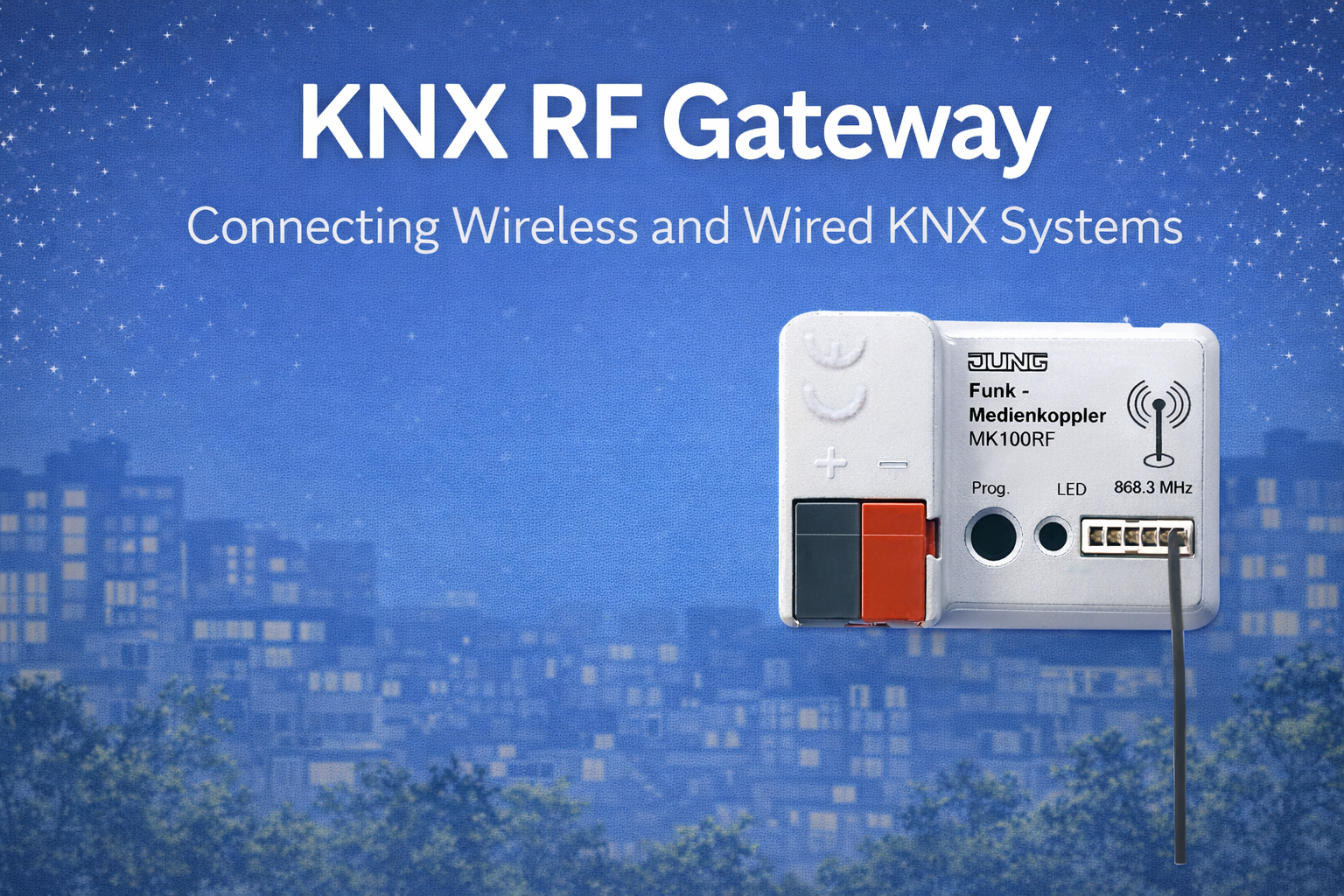
Battery performance is one of the most misunderstood aspects of KNX RF. Datasheets often promise multi-year lifetimes, yet real projects sometimes see batteries fail far earlier. The gap between promise and reality is almost always explained by design choices, configuration, and commissioning behavior—not by the protocol itself.
This article is a full technical deep dive intended for consultants and system integrators who need to predict, design, and verify KNX RF battery performance over many years of operation.
1. Why Power Management Is Central to KNX RF
KNX RF devices are designed around ultra-low power operation. Unlike KNX TP devices, they do not have continuous bus power and therefore rely on:
- Primary batteries (coin cell or lithium)
- Energy harvesting mechanisms
- Extremely short, infrequent radio transmissions
Power management is not a feature—it is the design foundation of KNX RF.
The behavior and constraints described here are defined within the KNX RF specifications maintained by the KNX Association, ensuring consistent behavior across certified devices.
2. Power States of a KNX RF Device (Technical View)
A KNX RF device typically cycles through four power states:
- Deep sleep
- MCU and RF transceiver off
- Power draw in microamp range
- Wake-up event
- Triggered by button press, sensor interrupt, or timer
- MCU active, RF still off
- RF transmission
- RF transmitter enabled
- Short telegram burst (milliseconds)
- Post-processing & return to sleep
Battery life is dominated not by sleep consumption, but by how often states 2 and 3 occur.
3. Energy Harvesting vs Battery-Powered Devices
3.1 Energy-Harvesting KNX RF Devices
These devices generate energy mechanically (piezo or electromagnetic) from the user action itself.
Key technical characteristics
- No energy storage beyond small capacitors
- Telegrams only possible immediately after actuation
- No cyclic or background communication
Implications
- Unlimited lifetime
- Zero maintenance
- Strictly event-driven behavior
Design limitation
- Suitable only for user input (switches, scene controllers)
3.2 Battery-Powered KNX RF Devices
Used for sensors and some actuators where energy harvesting is not possible.
Common battery types
- CR2032 / CR2450 coin cells
- Lithium primary cells
Typical electrical characteristics
- Nominal voltage: ~3 V
- Capacity: 220–620 mAh (coin cell dependent)
Battery life depends entirely on transmission frequency and processing time.
4. Telegram Transmission: The Real Energy Cost
The RF transmission phase consumes orders of magnitude more power than sleep.
Typical power draw comparison
- Sleep: microamps
- MCU active (no RF): low milliamps
- RF transmission: tens of milliamps (briefly)
Therefore:
One unnecessary telegram can cost as much energy as hours of sleep time.
5. Duty Cycle Regulations and Their Impact
KNX RF operates in a regulated sub-GHz band with strict duty cycle limits.
Design consequences
- Telegrams must be short
- Transmission frequency must be low
- Continuous updates are prohibited
This regulatory environment forces power-efficient design by default, but configuration mistakes can still drain batteries rapidly.
6. Configuration Parameters That Directly Affect Battery Life
6.1 Cyclic Transmissions (High Impact)
Many RF sensors allow cyclic updates (e.g., temperature every X minutes).
Technical reality
- Each cycle wakes the MCU
- RF transmission occurs even if value hasn’t changed
Best practice
- Avoid cyclic transmission unless explicitly required
- Prefer change-of-value transmission
6.2 Status Feedback Objects
Feedback objects are often enabled by default.
Problem
- Each state change triggers extra telegrams
- Multiple group addresses amplify RF traffic
Recommendation
- Enable feedback only where system logic truly needs it
- Avoid feedback for simple user interfaces
6.3 Scene Broadcasting
Scene controllers can trigger multiple devices at once.
Battery impact
- Scene button press = multiple outgoing telegrams
- Repeated scene use increases consumption
Mitigation
- Optimize scene group addressing
- Avoid unnecessary confirmation telegrams
7. RF Secure Overhead (Measured, Not Assumed)
KNX RF Secure adds:
- Encryption
- Authentication
- Replay protection
Technical impact
- Slightly larger telegram payload
- Marginally longer RF on-time
Real-world conclusion
- Battery impact is negligible compared to:
- Cyclic transmissions
- Excessive feedback
- Poor RF coverage causing retries
Security does not meaningfully reduce battery life when systems are designed correctly.
8. RF Quality and Retransmissions
Poor RF coverage leads to:
- Missed acknowledgements
- Automatic retransmissions
- Increased RF on-time
Each retry multiplies energy usage.
Design implication
Good RF coverage is also good power management.
Battery problems are often RF planning problems in disguise.
9. Commissioning Behavior and Battery Drain
A frequently overlooked factor is commissioning activity.
During commissioning:
- Devices wake repeatedly
- Multiple downloads occur
- RF traffic is unusually high
Best practice
- Commission efficiently
- Avoid repeated reprogramming
- Perform final configuration in one session
Commissioning abuse can consume months of battery life in hours.
10. Predicting Battery Life (Engineering Approach)
Battery life estimation should consider:
- Battery capacity (mAh)
- Average transmissions per day
- RF retry rate
- MCU processing time
- Environmental temperature (important!)
Practical rule of thumb
- Event-driven devices: 5–10 years achievable
- Cyclic sensors: 2–5 years (depending on interval)
Claims beyond this should be treated cautiously unless energy harvesting is used.
11. Environmental Factors
Temperature
- Cold reduces effective battery capacity
- High heat accelerates chemical aging
Installation location
- Exterior walls
- Unconditioned spaces
- Near heat sources
These factors are rarely mentioned but significantly affect lifetime.
12. Design Rules for Long Battery Life
Always
- Use event-based communication
- Plan RF coverage properly
- Minimize feedback objects
Avoid
- High-frequency cyclic updates
- Overloaded gateways
- Poor device placement
Battery life is a system outcome, not a device feature.
13. Maintenance & Lifecycle Planning
For professional projects:
- Document battery types and locations
- Estimate replacement intervals
- Align replacements with service visits
Well-documented systems never suffer “surprise failures”.
Conclusion
KNX RF battery life is not unpredictable—it is engineerable. When devices are configured correctly, RF coverage is planned properly, and commissioning is disciplined, KNX RF devices consistently deliver multi-year operation.
Short battery life is almost never a KNX RF limitation.
It is a design, configuration, or planning issue.
Mastering power management is essential for delivering stable, low-maintenance wireless KNX systems.